I Built an AI Tax Research Tool in 31 Days With No Code. Here's What I Learned.

I have spent 12 years doing corporate tax work at the Fortune level. I know what a well-researched tax answer looks like. I also know how hard it is to find one when you are a freelancer, a small business owner, a gig worker, or a nonprofit trying to figure out what you actually owe or what you are allowed to do.
Most people either overpay because they miss deductions, or they make expensive mistakes because they trusted the wrong source. The tools that exist are either built for enterprise companies with six-figure software budgets, or they are generic chat assistants that will confidently give you the wrong answer and move on.
I decided to build something different.
Day 1: No Code, No Problem
I am not a developer. I have basic computer skills. What I do have is 12 years of knowing exactly what a correct tax answer looks like and what a dangerous one looks like.
I started on March 14, 2026. I used Claude as my AI backbone, Next.js on Vercel for the platform, and I built every feature through a combination of planning sessions and Claude Code. No copy-paste disasters. No half-finished builds. Just a disciplined build process I designed from scratch.
By Day 31, the KKATC platform was live with multiple tools, 10 US states, and organic users in 22 countries.
$0 in advertising. All organic.
The BREAKER Program: Accountability as a Feature
Here is the part most AI tool builders will not do.
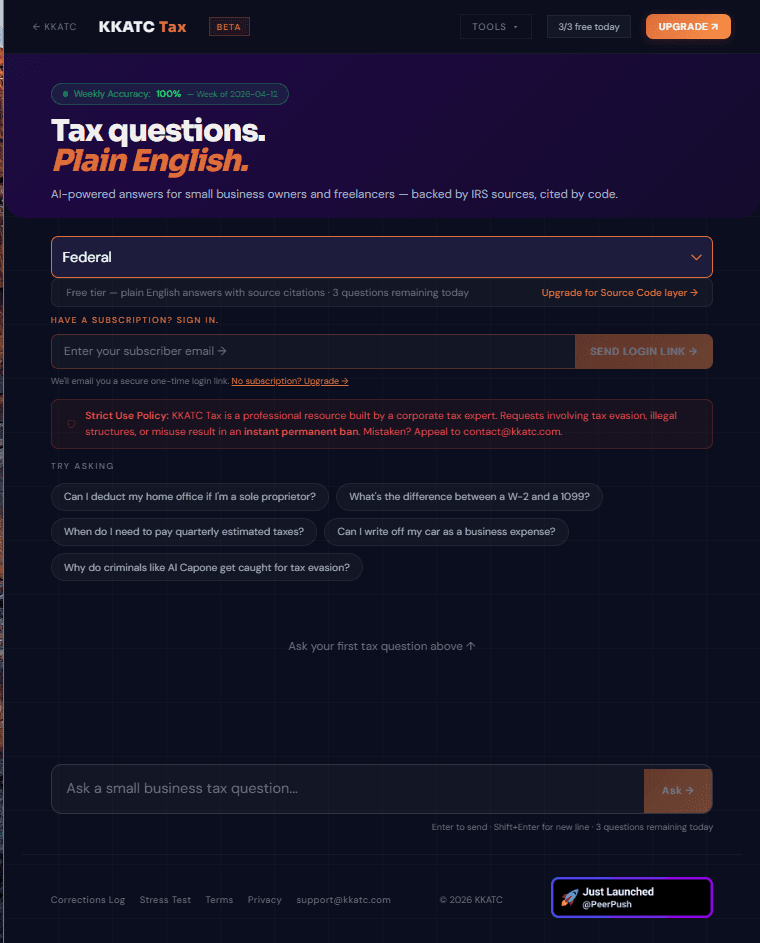
I built a stress testing program into the product from Day 1. Every week, 30 questions per tool, scored against an 8-point audit checklist. Results published publicly. Every error documented and hardcoded as a correction.
Then I took it further. If KKATC Tax falls below 92% weekly accuracy, the user who triggered the failure gets 3 months free.
I call it the BREAKER program.
Most AI products hide their error rates. I publish mine and pay people to find them. That is not a marketing gimmick. It is the only honest way to build a tax tool. When someone is relying on an answer to make a real financial decision, accountability is not optional.
Week 4 stress test result: 184/186. PASS.
The Tools
KKATC Tax is the flagship. Built for the people the enterprise tools ignore:
- Freelancers trying to understand 1099-NEC vs 1099-K
- Gig workers figuring out quarterly estimated taxes
- S-Corp owners navigating reasonable compensation and distribution strategy
- Crypto investors calculating cost basis, DeFi taxation, and FBAR exposure
- Estate planners working through federal exemptions, GST, and bypass trusts
- Real estate investors analyzing 1031 exchanges, depreciation recapture, and passive activity loss rules
- Anyone who has ever Googled a tax question and gotten three different answers
Every answer cites the actual IRC section, IRS publication, or Treasury regulation it is based on. Not a summary. Not a paraphrase. The source, linked directly. Federal coverage plus 10 US states including full New York 62-county routing.
KKATC Tax Foundation covers the nonprofit side. 501(c)(3) organizations face a completely different tax landscape - unrelated business income, intermediate sanctions, lobbying restrictions, and state exemption compliance. Foundation gives nonprofits and their advisors the same cited, accountable answers that KKATC Tax gives individual filers. Three confirmed beta organizations are already in the network, including veterans and first responder nonprofits.
KKATC Cards is the newest tool in the suite. Built for the sports card market - collectors, resellers, and breakers who need to track cost basis, calculate Schedule C income, and understand the difference between capital gains and ordinary income on their sales. The AI Grade Predictor evaluates card condition before you send to a grading service. Full inventory management, CSV exports, and IRS-ready Schedule C generation built in.
KKATC Consult connects you directly with a corporate tax expert for a one-on-one session when the tool answer is not enough. 15-minute free intro calls, 30-minute standard consultations, and 60-minute tax planning sessions available.
The Philosophy
Trust is the product. Revenue follows trust.
Every tool in the suite is built on the same foundation - government sources only, no interpretation beyond what the code says, mandatory CPA redirect when a question crosses into advice that requires a licensed professional.
KKATC is not trying to replace your accountant. It is trying to make sure you show up to that conversation informed.
31 Days In: What I Know
Building a product with no coding background is hard. Building a tax product with no coding background is harder. Building an honest tax product that publishes its own error rate and pays users to break it is the hardest thing I have done.
It is also the only version worth building.
If you want a tax research platform that tells you the truth, cites its sources, and stands behind its answers - KKATC is live at kkatc.com.
The first 3 questions are free. No credit card required.