Private Markets Have a $5 Trillion Data Problem

Private Markets Have a $5 Trillion Data Problem
Private markets move over $5 trillion per year. That number keeps growing.
More capital. More funds. More angels. More deals across more sectors and geographies than ever before.
But the infrastructure behind all of that has not kept up.
A retail trader can open an app and see real-time data, price movement, news, and analysis instantly. Someone writing a $250K check into a startup often cannot.
That gap is real, and it shows up every day in how private markets actually operate.
The Gap Nobody Talks About
Public market investors have had structured intelligence for decades.
They have terminals, real-time feeds, analyst coverage, filings that are searchable within minutes, and earnings data that is available the same day.
Private markets look nothing like that.
Most investors build their view of the market from scattered inputs:
- a newsletter
- a Twitter thread
- a conversation over dinner
- a few databases if they have access
- maybe a Notion doc to tie it all together
None of these sources are designed to work together. None of them are complete. Most of them are delayed.
So the people making real capital allocation decisions are often working with partial information that is already out of date.
What This Actually Costs
The cost is not always obvious, but it compounds quickly.
A lot of investors spend over 10 hours a week just trying to understand what is happening in their sectors. Not analyzing deals. Not making decisions. Just getting to a baseline view of the market.
Signals get missed because they were buried in the wrong place.
A sector starts heating up, but the shift is only obvious weeks later when everyone is already talking about it.
Risk shows up early, but it is scattered across sources that are never connected.
Decisions end up being slower and less informed than they should be.
In private markets, speed and context matter. When you are late, someone else has already written the check.
Why This Problem Has Always Existed
Private markets were not built around transparency.
For a long time, the advantage came from information asymmetry. If you knew about a deal early, or understood a market better than others, that was your edge.
That model worked when the ecosystem was smaller.
Fewer funds. Fewer startups. Fewer deals.
Relationships were enough to keep up with what mattered.
But that is no longer the case.
The number of players has increased. The number of sectors has expanded. Capital moves faster. Information spreads unevenly.
No single network can track all of it anymore.
The old model still exists, but it does not scale.
What the Next Layer Looks Like
What is starting to emerge now is a different approach.
Instead of relying on fragmented inputs, the idea is to build an intelligence layer that continuously tracks what is happening across private markets.
That includes:
- sector momentum — which areas are accelerating and which are cooling
- funding velocity — where capital is concentrating and how quickly rounds are closing
- startup discovery — not just who raised, but which companies are appearing and gaining traction
- risk signals — early indicators that tend to show up before they become obvious
And importantly, it aligns with how an investor actually operates: stage, geography, sector, check size.
The goal is not more data.
It is better structured data that is easier to act on.
The Missing Layer: A Simple Way to Consume It
The challenge is that not everyone needs a full terminal on day one.
Most founders and investors just need a clear, consistent read on the market.
That is where something like The Brevoir Signal comes in.
It is a twice-weekly newsletter built around the same idea: turn fragmented private market activity into something structured and readable.
Each issue focuses on:
- what actually changed this week
- which sectors are gaining or losing momentum
- where capital is concentrating
- what recent deals imply about the market
It is essentially the simplest version of private market intelligence: a recurring briefing instead of scattered inputs.
For many people, that is the first step before adopting deeper tools.
What This Looks Like in Practice
A new category of tools is starting to take shape around this idea.
These platforms bring together market signals, startup activity, and investor workflows into a single system. The focus is on helping investors understand what is happening now instead of reconstructing the past.
The emphasis is also on quality:
- source attribution
- confidence in signals
- early visibility into change
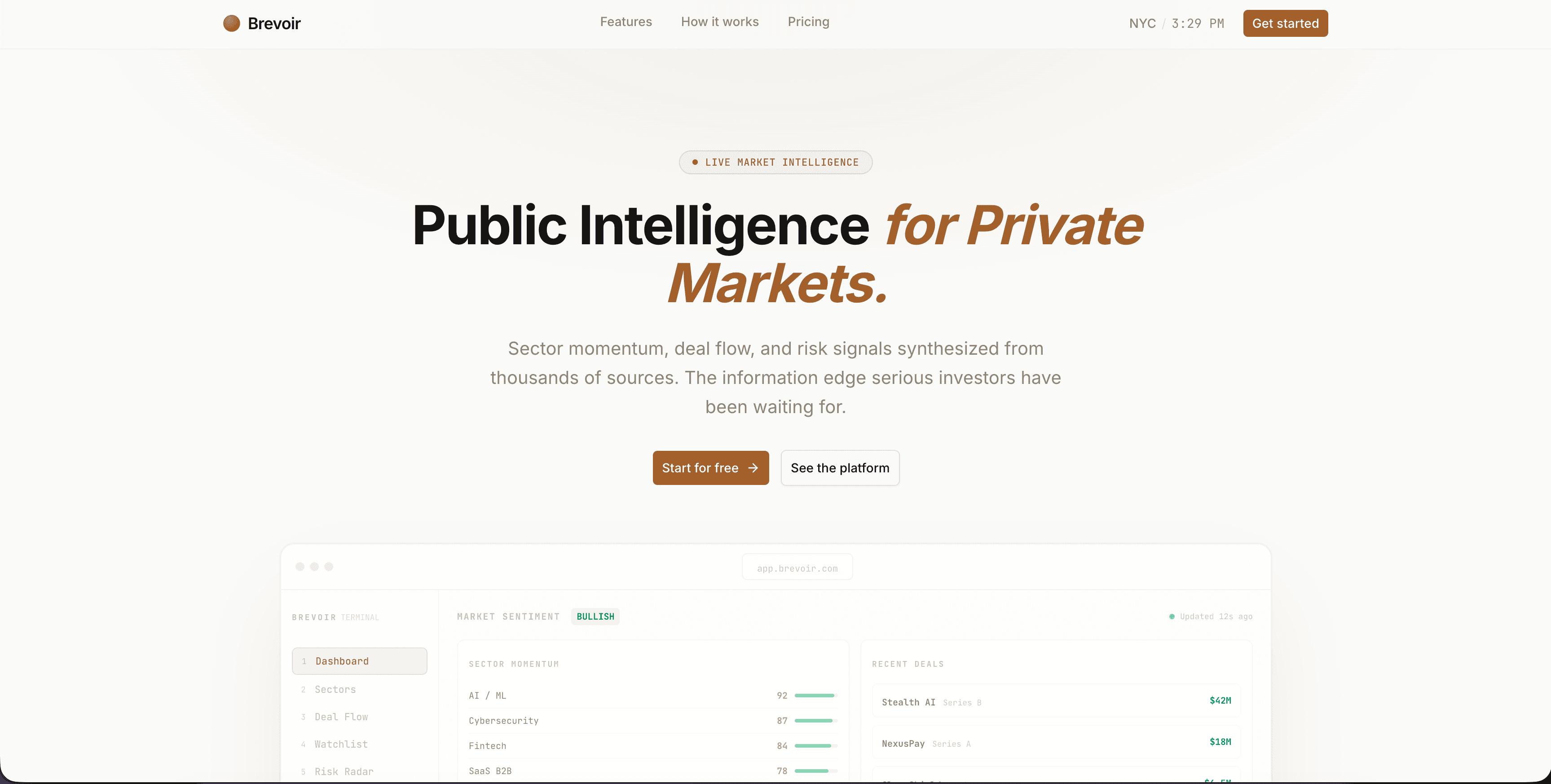
One example of this approach is Brevoir, which provides a terminal-style interface for tracking sector momentum, funding activity, startup discovery, and risk signals in one place.
Instead of acting as a static database, it is designed to give a live view of the market so investors can move with it.
The Shift Is Already Happening
The way people invest in private markets is starting to change.
More investors are looking for ways to make their process more systematic.
More LPs expect structure behind how deals are sourced and evaluated.
More funds are realizing that fragmented information does not hold up when the market is moving this quickly.
The investors who adapt earlier will not necessarily have better information.
They will have better access to organized information.
And that changes everything.
Closing the Gap
Public markets solved their data problem decades ago.
Private markets are just starting to.
The gap has been obvious for a long time. What is new is that the infrastructure to close it is finally being built.
And the first layer of that shift is not necessarily complex software.
It is simply making market intelligence easier to access, understand, and act on.
That is what tools like Brevoir aim to do at scale.
And that is what the earliest layer, through something like The Brevoir Signal, is already starting to unlock.