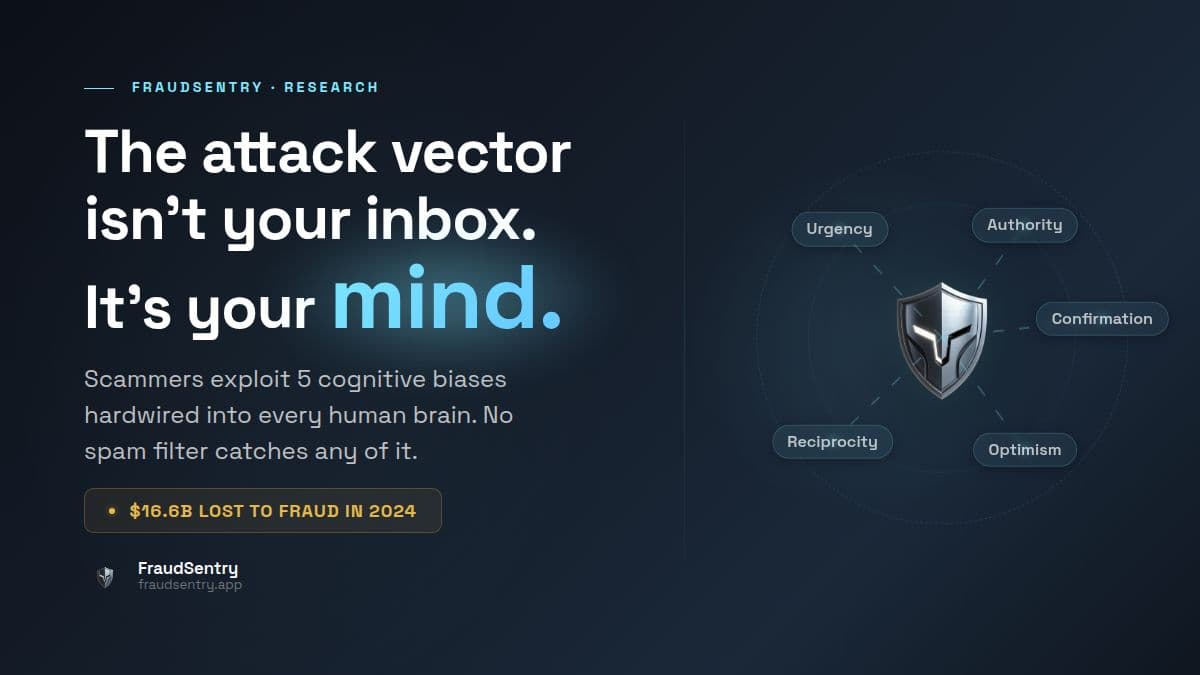
Why Smart People Fall for Scams: The 5 Biases Scammers Exploit

Americans lost $16.6 billion to fraud in 2024 — a 33% jump in one year, during a period when spam-blocking and antivirus tech was better than ever. That disconnect reveals something most founders and security people get wrong: modern scams don't beat your inbox. They beat your brain.
A romance scammer doesn't bypass your firewall. They bypass your judgment. A pig-butchering crypto scheme doesn't exploit a software vulnerability — it exploits your confirmation bias. An IRS impersonation text doesn't install malware. It triggers authority bias, the instinct to comply when something looks official. No spam filter catches any of that, because the attack vector isn't your inbox. It's your mind.
The Mind Virus
Consider what a computer virus does: it infiltrates a system, disguises itself as something legitimate, alters normal behavior, and extracts value — all while the system keeps believing it's running fine. Scams operate identically on human brains. They arrive through trusted channels (a bank text, a match on a dating app, a recruiter DM), look legitimate, hijack your decision-making through urgency or emotion, and extract your money while you believe you're making rational choices.
Research confirms intelligence doesn't protect you. AARP researcher Doug Shadel documented PhDs, millionaires, and senior law partners losing money to scams. The FTC found younger adults (20–29) lose money to fraud more often than older adults (70–79) — 44% vs. 24%. Stanford and FINRA research found that heightened emotional arousal — excitement, anger, or fear — significantly increases fraud susceptibility.
The 5 Biases Every Scammer Exploits
- Urgency bias — "Act now or your account closes." Compresses your decision window below the threshold where rational evaluation happens.
- Authority bias — A message from the IRS or Microsoft carries weight because your brain defers to perceived authority. Impersonation scams caused $2.95B in losses in 2024 alone.
- Confirmation bias — Once you believe a crypto platform is legit, you seek evidence that confirms it and dismiss red flags. Pig-butchering runs on this.
- Optimism bias — "That won't happen to me" prevents you from seeing you're already inside the scam.
- Reciprocity bias — A romance scammer invests weeks of emotional attention and your brain feels obligated to reciprocate. The FBI documented $672M in romance fraud losses in 2024.
Why Smart People Aren't Immune
Educated professionals are more susceptible to investment fraud because they have higher confidence in their ability to evaluate opportunities. That's exactly the vulnerability pig-butchering exploits. The Sift Q2 2025 Digital Trust Index found 27% of consumers targeted by GenAI-powered scams were successfully defrauded — a 62% year-over-year increase. AI now generates perfect grammar, authentic logos, and cloned voices. The traditional tells are gone.
Prebunking: Real Cognitive Immunity
Cambridge University and Google Jigsaw research shows that exposure to manipulation tactics before you encounter real attacks — a technique called prebunking — measurably improves your ability to recognize fraud in real-world conditions. It's the cognitive equivalent of building natural immunity through experience. Not warnings. Not fear-based PSAs. Actual exposure to the mechanism of deception so your brain learns to recognize it when it matters.
What This Means for Builders
The most effective fraud protection isn't a tool that filters messages — it's one that explains how the manipulation works in the moment of threat. Pattern recognition. Tactic exposure. Evidence-based analysis. Actionable next steps. Every scan becomes a learning event that compounds cognitive immunity.
That's the principle FraudSentry was built on. Paste a suspicious message and you don't just get a verdict — you get a breakdown of the exact psychological tactics being deployed against you, the biases they're exploiting, and clear next steps. Understanding the tactic is the defense.
The question was never whether you're smart enough to spot a scam. The question is whether you can see the tactic before it sees you.