The Problem: The "Data Hairball"
Building modern applications—especially AI-driven ones—requires duct-taping together a complex nightmare of different systems. Today, a standard tech stack often includes PostgreSQL for user data, Redis for caching, Elasticsearch for text search, Neo4j for relationships, and Pinecone for AI vector search.
This fragmented approach creates massive problems for companies:
Sky-High Cloud Bills: Companies pay a premium to host, manage, and scale 5+ different database servers.
Engineering Sinkholes: Developers waste up to 40% of their time just trying to keep data synchronized and pipelines flowing between these separate systems.
High Latency: Moving data between multiple specialized databases takes time, causing applications and AI agents to respond slowly.
The Solution: NodeDB
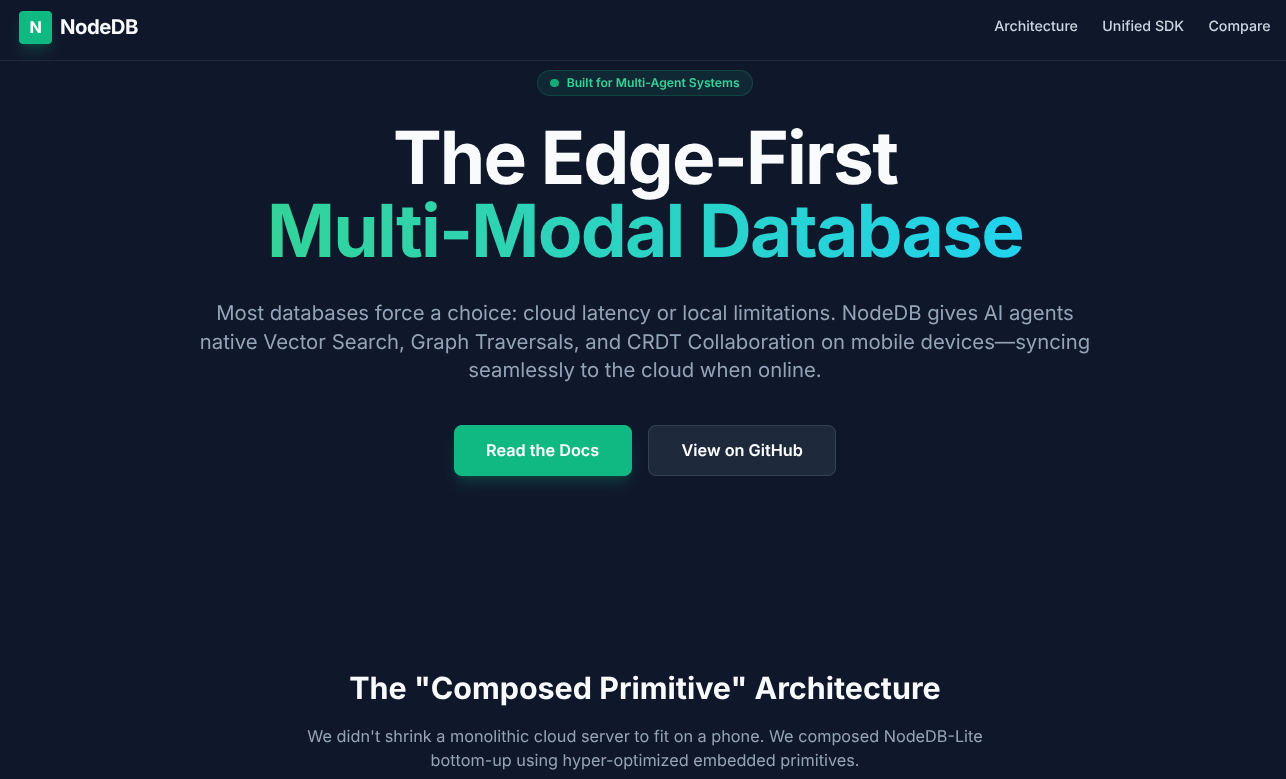
NodeDB is a hyper-efficient, universal database built from the ground up in Rust. It replaces all of those separate data systems with one single, unified program. It is designed to give developers 95% of the performance of highly specialized databases, with 0% of the complex maintenance.
How it works & Core Features:
All-in-One Processing: NodeDB natively handles complex relationships (Graph), AI embeddings (Vectors), fast analytics (Columnar), text search, and standard data (Documents) all at the exact same time, in the same place. An AI agent can look up a user, map their relationships, and run a vector search in one millisecond.
Frictionless Integration: NodeDB "speaks" the exact same language as PostgreSQL. Developers can plug it directly into their existing applications and tools without having to rewrite their code or learn a new query language.
Unmatched Efficiency: Because it is built on a modern Rust architecture, it punches far above its weight class. In benchmarks, NodeDB ingests massive amounts of data faster than specialized analytics giants like ClickHouse, while using 8 times less memory.
Edge-to-Cloud (Offline-First): NodeDB isn't just for massive cloud servers. It can compile down to a tiny 4.5 MB file that runs directly inside a smartphone or web browser. This enables true "offline-first" mobile apps—if a user loses cell service, the app keeps working perfectly using the local NodeDB, and automatically syncs with the main server the moment the internet connection returns.
Whether you are an AI startup looking to streamline your stack to just one database, a mobile agency building offline-first apps, or an enterprise looking to cut cloud infrastructure costs by 80%, NodeDB is the only database you need.





Comments (2)
Excited to use nodeDB on my next project, next generation DNS sinkhole. Leveraging nodeDB multi-modal capabilities and advance CRDTs features.
I'm not technically-inclined by any means but I wanted to ask, is this beginner friendly or is this specifically for IT experts? Thanks, your product looks great!
@baileytinn This is actually for developers. However, it is quite easy to use, even for begginer developers.