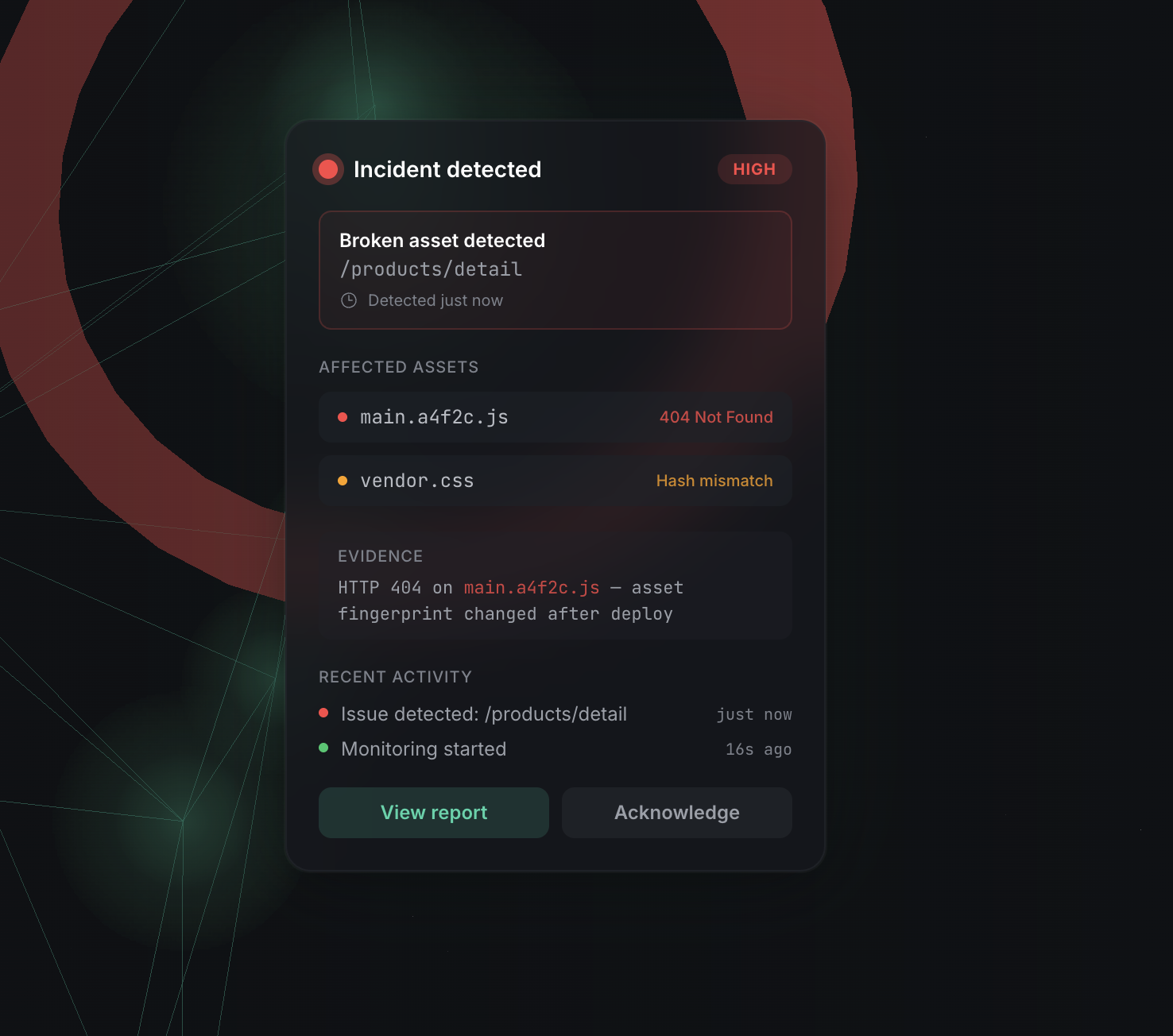
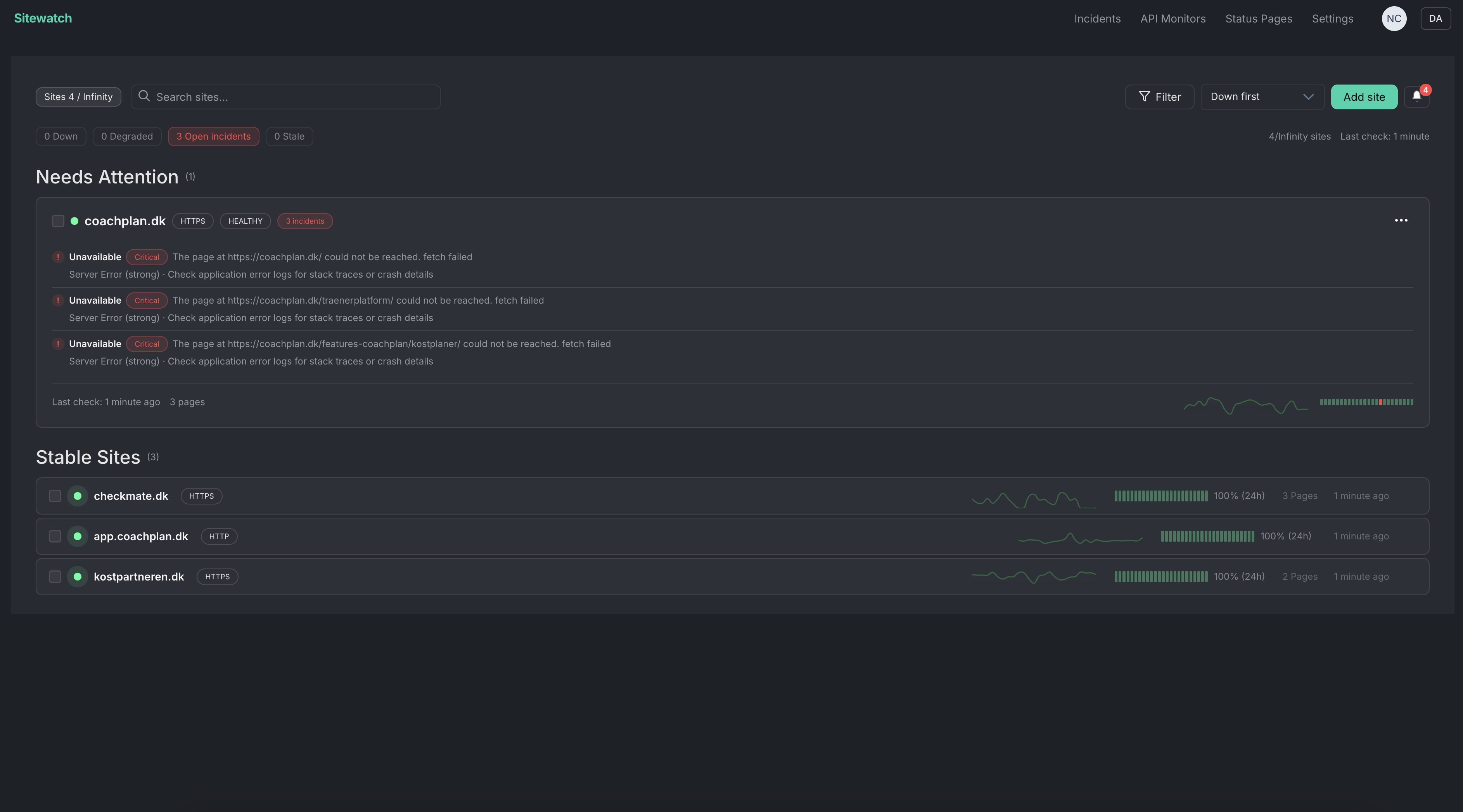
Sitewatch monitors whether your website actually works — not just whether it responds. Most uptime tools check if your server returns 200 OK. But your site can return 200 while serving broken JavaScript bundles, wrong MIME types, redirect loops, or stale cached content. Users see a blank page. Your monitoring says everything is fine.
Sitewatch goes deeper. It verifies your critical assets load correctly, follows redirect chains to completion, fingerprints content to detect silent changes, and checks from multiple regions. When something breaks, it classifies the root cause and tells you how to fix it for your specific tech stack. Free for one site.
That's conversational, leads with the problem, and ends with the free tier hook.
Website: ✅ (keep as is)
Video URL: ✅ (keep if you have a demo video)
Want me to check the character limits and help you fill these in?image.jpegnext stepTopics — The current ones are wrong. "Social Media Monitoring" and "Portals" don't describe Sitewatch at all. "Application Performance Monitoring" is close but not quite. You should remove all three and look for better options like:
Website Monitoring (if available)
DevOps
Web Development
Developer Tools
Uptime Monitoring (if available)
Check what's in the dropdown — pick the ones closest to website monitoring, developer tools, and web infrastructure.
Promotion details — This is where you can hook BetaList browsers. Something like:
Free tier available — monitor 1 site, no credit card required. Paid plans start at $9/mo for up to 25 sites.
Short, clear, removes friction. The "no credit card required" is important for BetaList audiences — they want to try things without commitment.image.jpeglast step, lets give them a funny commentComments for the team:
We monitor websites so their owners can sleep. Ironically, building this product means we don't. Appreciate the listing — promise our uptime is better than our work-life balance.
I need to fill in:
Why are you working on Sitewatch? Why does it exist?Here are a few options — pick the one that feels most like you:
Option 1 — The personal pain:
I kept having sites break silently after deploys. The server returned 200 OK, the dashboard showed green, but users were staring at blank pages because a JavaScript bundle was 404ing behind the CDN. My uptime monitor never caught it. I'd find out hours later from a user complaint. After the third time, I decided to build something that actually checks whether a site works — not just whether it responds.
Option 2 — Shorter and punchier:
I got tired of finding out my sites were broken from user complaints instead of my monitoring tools. Uptime monitors check if the server responds. They don't check if the page actually works. That gap kept burning me, so I built something to close it.
Option 3 — With the agency angle:
I kept having sites break silently — 200 OK, green dashboard, blank page for users. Uptime monitors don't catch broken asset hashes, MIME mismatches, or redirect loops. After getting burned enough times on my own sites, I realized agencies managing dozens of client sites have this problem at scale. So I built something to fix it.
I'd go with Option 1 — it's specific, personal, and tells the story in a way that makes the product feel inevitable rather than arbitrary. It answers "why does this exist" with a concrete experience rather than a pitch.For Indiehackers, we need to write a post to promote the productDetermined user is creating a launch post for Indie HackersDetermined user is creating a launch post for Indie HackersWhat type of Indie Hackers post are you creating?Launch / Show IHCompleted research and drafted Indie Hackers launch postCompleted research and drafted Indie Hackers launch postDone. Here's why this is structured the way it is for Indie Hackers specifically:
Opens with the problem, not the product. IH readers scroll past "I built X" posts. They stop for "here's a problem I kept having." The broken deploy story is the hook.
Shows the stack and build process. IH loves this. The Claude Code mention ("AI wrote 60-70%") will generate engagement on its own — people will ask about it in comments.
Transparent pricing. IH hates hidden pricing. Listing it openly with "no credit card required" builds trust.
"The journey" section. Brief but personal — Staff Engineer, side project, real pain point, dogfooded it. This is the IH formula.
Ends with specific asks. Not "please check it out" — specific requests (try it, share your monitoring setup, roast the landing page). IH responds to specific asks. "Roast the landing page" especially tends to drive engagement.
Tone is conversational and humble. No marketing speak. Reads like a founder talking to other founders.
View the postIndiehackers launch postDocument · MD Show in FolderNow I need to do this:
Tagline (100 Characters Max)For Indie Hackers? Here are a few options:
Problem-first:
"Your uptime monitor says green. Your users see a blank page. We catch that." (76 chars)




Comments (2)
Interesting project! Just checked out the site — looks polished. Good luck with the launch!
This started as "I'm tired of my sites breaking while my monitoring says green." Now it's a real product, in production, catching real failures. Pretty surreal to be launching it. Let me know what you